Thursday, December 12, 2024

Next-Generation Firewalls (NGFW): What Are They and Why Are They Important?


Next-Generation Firewalls (NGFWs) are a new generation of network security, providing more advanced features beyond traditional firewalls to prevent modern cyber threats. 


What Are Next-Generation Firewalls (NGFW)?

NGFWs are advanced security solutions that combine the core functionalities of traditional firewalls with additional layers of protection. They go beyond simple port and protocol blocking to provide:


Application Awareness: Identify and control applications, regardless of port or protocol.

Integrated IPS: Identifies and blocks threats in real-time.

User Identification: Identifies the users responsible for network activity, rather than IP addresses.

DPI: Examines the contents of data packets to detect malicious activity.

Encrypted Traffic Management: Examines and filters encrypted traffic, such as HTTPS, to detect hidden threats.

Key Features of NGFWs

Advanced Threat Protection

Advanced malware, ransomware, and zero-day threat detection and mitigation with both signature-based and behavioral methods

Granular Application Control


Allow or block specific applications based on policies, such as permitting Facebook usage but disabling file uploads.

SSL/TLS Inspection


Examine encrypted traffic to prevent malware and data exfiltration from hiding in HTTPS streams.

Integrated Cloud Security


Provide seamless integration with cloud environments to protect hybrid infrastructure.

Automation and Machine Learning


Use AI-driven insights for proactive threat detection and reduced false positives.

Why Are NGFWs Important?

Protection Against Sophisticated Threats


Cyber attacks are becoming sophisticated, bypassing the traditional firewalls most of the time. NGFWs offer strong mechanisms to detect and prevent such threats.

Adaptability to Modern Workflows


Organizations increasingly rely on cloud-based services, remote work, and IoT devices, all of which demand advanced, adaptable security measures.

Compliance and Regulatory Needs


Organizations with high compliance requirements (e.g., GDPR, HIPAA) find that NGFWs provide comprehensive monitoring and reporting capabilities.

Consolidated Security


By integrating several security features in a single device, NGFWs simplify management, save costs, and reduce performance bottlenecks.

Advantages of Implementing NGFWs

Increased Visibility

Understand the network traffic, applications, users, and threats with granular details.

Stronger Security Position

Be one step ahead of attackers with real-time updates and threat intelligence.

Cost-effectiveness

Replace multiple point solutions with a single, integrated platform.

Scalability

NGFWs are built to grow with your organization and accommodate dynamic and distributed environments.


Use Cases for NGFWs

Corporate Networks prevents unauthorized access to sensitive data; it provides secure remote access.

Educational Institutions: Block inappropriate or risky applications while protecting student and staff data.

E-commerce Platforms: Secure payment gateways and protect from fraud.

Cloud-First Organizations: Security Integration across On-Premises and Cloud Infrastructures.

Wednesday, December 11, 2024

The Role of Behavioral Analytics in Detecting Cyber Threats


Behavioral analytics is important in detecting cyber threats through the analysis of patterns of user and system behavior for anomalies that may indicate malicious activity. Here's a breakdown of its role:


1. Understanding Normal Behavior

  • Behavioral analytics builds a baseline of typical user and system behavior by analyzing historical data. This includes:


Login times and locations

  • File access patterns
  • Network usage metrics
  • Application activity
  • With this understanding of what "normal" looks like, anomalies can be quickly identified.


2. Anomaly Detection

Behavioral analytics systems alert on any deviations from the norm, including but not limited to:

  • Access from unusual login locations or times (access from another country).
  • Unusual spikes in data transfers (exfiltration attempts).
  • Unauthorized access to sensitive files.
  • These are often indicators of potential security breaches or insider threats.


3. Real-Time Threat Detection

Today's behavioral analytics systems operate in real time, providing alerts on suspect activities. These include but are not limited to:

  • Multiple unsuccessful login attempts with a successful one in a row (brute-force attack).
  • Unusual commands executed in a system (malware activity).
  • Abrupt privilege escalations.

4. Countermeasures against Insider Threats

Behavioral analytics is particularly powerful against insider threats because insider threats usually involve people who have legitimate access to systems. Indicators might include:

  • Accessing data outside the typical work hours.
  • Downloading unusually large amounts of data.
  • Using devices or applications not previously associated with the user.


5. Integration with Advanced Security Tools

Behavioral analytics is integrated with other cybersecurity mechanisms, including:

  • SIEM (Security Information and Event Management): This aggregates information from the entire organization to correlate anomalies.
  • Machine Learning Algorithms: These continuously refine detection capabilities based on new data.
  • Threat Intelligence Feeds: These enhance behavioral insights with external threat data.

6. Incident Response

  • Behavioral analytics helps in improving incident response efficiency by pointing out the nature and source of an anomaly. Security teams can thus focus on high-risk anomalies and eliminate false positives.
  • Act quickly to mitigate and remediate threats.


Real-World Use Cases

  • Rhishing Attacks: Detect when a user accesses a known phishing site or downloads suspicious files.
  • Ransomware: Anomaly detection of rapid encryption of files.
  • Credential Theft: Anomaly detection of abnormal login behavior that could be indicative of stolen credentials.

Sunday, December 8, 2024

What is Multi-Factor Authentication and How Does it Work?


What is Multi-Factor Authentication?

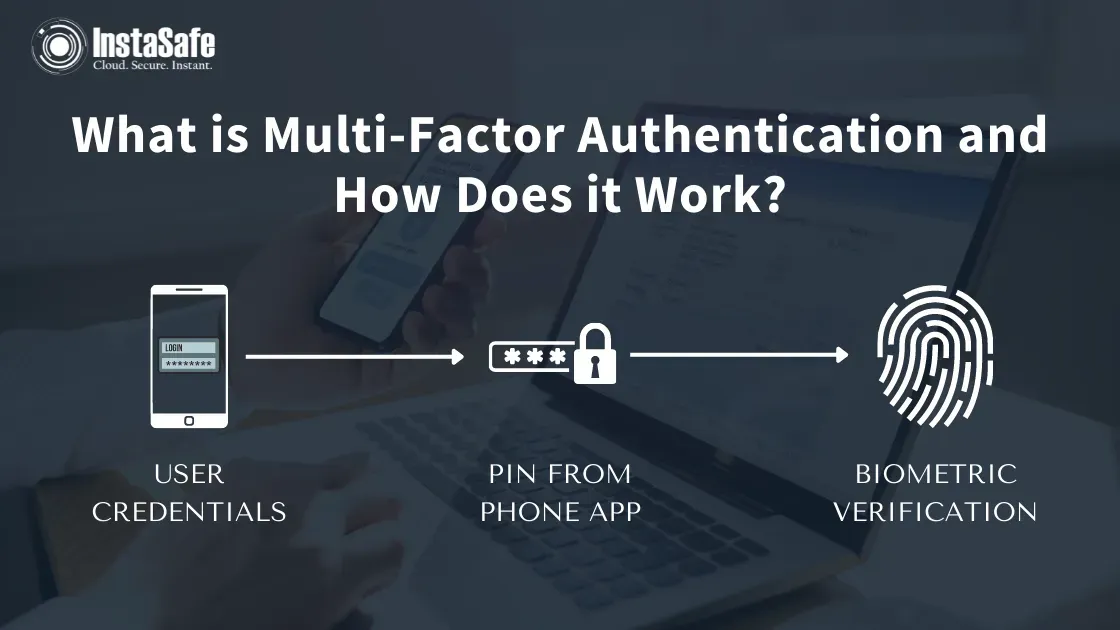
Multi-Factor Authentication is an identity verification process where more than one factor of verification must be provided by a user to gain access to an account, application, or system. This process includes an additional layer of protection in which more than one kind of credential is combined to provide authentication; hence, it becomes more challenging for the attacker to enter any unauthorized access.


How Does MFA Work?

MFA employs at least two of the three kinds of authentication factors that include:

1Something You Know

  • Examples: Passwords, PINs, or answers to security questions.
  • This is the most commonly used and most known factor.

2. Something You Have

  • Examples: Smartphones, security tokens, smart cards, or hardware keys.
  • Users get a one-time passcode (OTP) by way of text, email, or an app, or a physical device for the purpose of identity verification.


3. Something You Are

  • Examples: Biometrics such as fingerprint, facial recognition, or iris scans.
  • These are unique to a person and hard to be duplicated.


Steps of the MFA Process

  1. Login Attempt: A user types in his username and password (first  factor).

  2. Second Factor Request: The system asks for another verification  factor such as OTP or fingerprint.

  3. Verification: The user gives the second factor and the system verifies his identity.

  4. Access Granted: If both factors are correct, the user is granted  access.


Common Methods of MFA

 1. SMS-Based OTPs

  • A one-time passcode sent to the user's mobile phone.

 2. Authenticator Apps

  • Apps like Google Authenticator or Microsoft Authenticator generate time-sensitive codes.

 3. Push Notifications

  • A notification sent to a trusted device for approval.

 4. Hardware Tokens

  • Physical devices like YubiKeys generate OTPs or provide secure access keys.

 5. Biometric Verification

  • Fingerprint, face, or voice recognition.

 6. Email-Based Verification

  • A code or link sent to the user’s email address.


Why is MFA Important?

 1. Increased Security

  • It guards against the usual threats like phishing, password theft, and brute-force attacks.

 2. Compliance

  • Many regulations, such as GDPR and HIPAA, require MFA for safe access to sensitive data.

 3. Decreased Risk

  • Even when one factor, such as a password, is compromised, there is still the safety net of other factors.

 4. User Confidence

  • Guarantees that users feel their accounts are secure, which gives them confidence in the system.


Challenges and Limitations of MFA


  • Convenience vs. Security: Users might view MFA as inconvenient or time-consuming.
  • Device Dependence: In the loss or unavailability of a trusted device, it locks users out.
  • Cost: Hardware, software, and training expenses for MFA in an organization
  • Sophisticated Attacks: Methods like SIM swapping can bypass SMS-based MFA


Best Practices in the Implementation of MFA

 1. Inculcate Strong First Factors

  • Make use of strong and unique passwords with MFA.

 2. Use Secure Methods

  • Use authenticator applications or hardware tokens instead of OTPs received over SMS: those are vulnerable to attack.

 3. Refreshing

  • Update the MFA policies and raise awareness by the users for emerging risks

 4. Backup Recovery

  • Options available for backup recovery purposes: for instance, Backup Codes or recovery through some secondary devices.

Understanding Threat Hunting: Proactively Searching for Cyber Threats


What is Threat Hunting?

Threat hunting is a proactive cybersecurity practice that involves actively searching for hidden threats within a network before they cause harm. Unlike traditional methods that react to alerts from security systems, threat hunting seeks to uncover malicious activity that might evade automated defenses.


Why is Threat Hunting Important?

  • Advanced Threats: Cybercriminals use sophisticated techniques that bypass traditional detection tools.
  • Reduced Dwell Time: Threat detection early decreases an attacker's dwell time into a system, minimizing loss.
  • Better Defense Capabilities: Hunting insights benefit broad cybersecurity planning.


Core components of Threat Hunting

Creating Hypotheses

  • In the hunting process, someone begins with an assumption-such as "An attacker might exploit a vulnerability in our remote desktop protocol."
  • Common bases for developing hypotheses come from threat intelligence, new or recent incidents, and anomalies.


Data gathering and processing

  • Use tools such as SIEM, EDR, and network traffic analyzers to collect data.
  • Analyze logs, user activity, and system behavior to identify anomalies.


Techniques Used

  • TTP Analysis: Identify tactics, techniques, and procedures (TTPs) used by attackers.
  • Behavioral Analytics: Understand deviations from normal user or system behavior.
  • Anomaly Detection: Identify unusual patterns in data or network traffic.


Threat Intelligence Integration

  • Combine external intelligence (for example, known attack signatures, Indicators of Compromise) with internal observations.


Response and Remediation

  • Once a threat is detected, steps are taken to neutralize it. Steps may include isolating systems, applying patches, or updating rules in detection tools.


The Role of Technology in Threat Hunting

  • Automation: AI and ML help to sift through massive datasets to look for anomalies.
  • Visualization Tools: Dashboards help create patterns and trends in network activity.
  • SandboxingIsolate suspicious files or programs into sandboxing for detailed analysis.


Who are the threat hunters?

Threat hunting is the activity of the skilled cyber security professionals who are also known as the threat hunters. They work in Security Operations Center. These threat hunters have extensive knowledge and experience in fields such as digital forensics, malware analysis, and network security.


Benefits of proactive threat hunting

  • Early Detection: Attacking before they cause substantial damage.
  • Reduces False Positives: Focus on real threats and not simply alerts from automated tools.
  • Continuous Improvement: Reinforces security controls through weakness identification.


Threat Hunting Challenges

  • Data Overload: Sorting through enormous volumes of data is complicated.
  • Resource-Intensive: Requires experienced professionals and expensive tools.
  • Evolving Threats: Emerging methods of attack require constant updates.


How to Build an Effective Threat Hunting Program

    1. Set clear goals and identify your most important assets.

    2. Use threat intelligence to inform your hunts.

    3. Invest in tools and technologies that support deep data analysis.

    4. Train your threat hunters on emerging threats and techniques     regularly.

Friday, December 6, 2024

How AL is Transforming Cybersecurity Right Now?


AI is revolutionizing cybersecurity, which allows organizations to better protect assets, detect threats faster, and respond more efficiently. Here is how AI is changing the landscape in cybersecurity:


1. Improving Threat Detection

AI uses ML algorithms to mine big data and find patterns characteristic of cyber threats. Unlike traditional methods, AI learns and improves detection capabilities continuously:

  • Malware-Identifying unknown malware by Behavioural analysis.
  • Ransomware-Identifying unusual encryption actions.
  • Phishing Attacks-email content and metadata scanning for malicious intents.


2. Automation of Responses

AI-powered systems can.

  • Prioritize Threats-De-noise the system so that only the most imperative issues are shown.
  • Neutralize Attacks-Automatically throw the affected systems or block ip addresses to neutralize the current threats.
  • Speed up the investigative process-Save time while the security analysts trace what is causing the incidents that are happening.


3. Behaviour Analysis

AI monitors user activity using behavioral analytics to detect anomalies such as:

  • Unusual login locations or times.
  • Abnormal access to sensitive files.
  • Suspicious use of privileged accounts.

4. Predictive Security

AI models can analyze historical data to predict future attack patterns, and organizations can implement preventative measures proactively.


5. Advanced Fraud Detection

In the financial sector, such as in banking and e-commerce, AI is used extensively to identify fraudulent transactions by identifying subtle deviations in behavior or transaction patterns.


6. Phishing and Email Security

AI tools can:

  • Filter phishing emails with high accuracy.
  • Flag impersonation attempts using NLP to understand the context of messages.


7. Vulnerability Management

  • AI scans software and networks to identify vulnerabilities, prioritize them based on exploitability, and recommend fixes.


Challenges in AI Adoption

  • Adversarial AI: Cybercriminals use AI to create more advanced attacks, like deepfakes or adaptive malware.
  • False Positives/Negatives: Balancing sensitivity and accuracy remains a challenge.
  • Skill Gaps: Needs expertise to operate and optimize AI-based security systems.


AI in Cybersecurity's Future

  • AI-Based SOCs: Integrated AI systems will perform complex incident responses.
  • Zero Trust Architectures: AI will be used to enforce access controls and ensure that only authenticated users access sensitive data.
  • AI and Blockchain: Security will be amplified by combining blockchain's transparency with AI's pattern recognition capabilities.

"Find Out What Your Website’s Missing – Let’s Talk Today"

Artificial Intelligence in Cybersecurity


Role of AI in Cybersecurity

AI transforms the approach to strengthening cybersecurity by detecting threats and responding to them faster than humans. It utilizes machine learning (ML), natural language processing (NLP), and pattern recognition to scan large datasets for anomalies and predict potential threats.


Key Applications

1. Threat Detection and Prevention

  • AI can recognize patterns related to malware, ransomware, or phishing attacks by scanning network traffic, user behavior, and system activities.
  • Example: AI-based Intrusion Detection Systems (IDS), which scan network anomalies on the fly.


Automated Incident Response

  • AI-based tools automatically filter alerts, eliminate unnecessary false positives, and will even take action to terminate threats.
  • Example: SOAR platforms: Security Orchestration, Automation, and Response.


Behavioral Analytics

  • AI monitors user and system behavior to identify anomalies typical of insider threats or compromised accounts.


Fraud Detection

  • Financial services use AI to identify fraudulent transactions based on historical data and patterns of behavior.


Phishing Prevention

  • AI tools can assess the content of an email, flagging phishing attempts with high accuracy.


Vulnerability Management

  • Predicts and identifies application, system, or network security flaws before they get exploited.


Benefits of AI in Cybersecurity

  • Efficiency: Automates threat detection and mitigation, reducing response time.
  • Accuracy: Minimized human error and false positives.
  • Proactive Defense: Anticipates and mitigates future threats.


Challenges and Limitations

  • Adversarial AI: Attackers use AI to develop more sophisticated threats.
  • Data Privacy: AI systems need large datasets, which can raise privacy issues.
  • Skill Gap: Effective deployment of AI requires both cybersecurity and AI-specific skills.


Future of AI in Cybersecurity

  • Increased dependence on AI-based predictive tools.
  • AI and human analysts will collaborate more effectively.
  • Ethical AI frameworks will be developed to prevent misuse.

Thursday, December 5, 2024

What Is Zero Trust Architecture and How Does It Work?


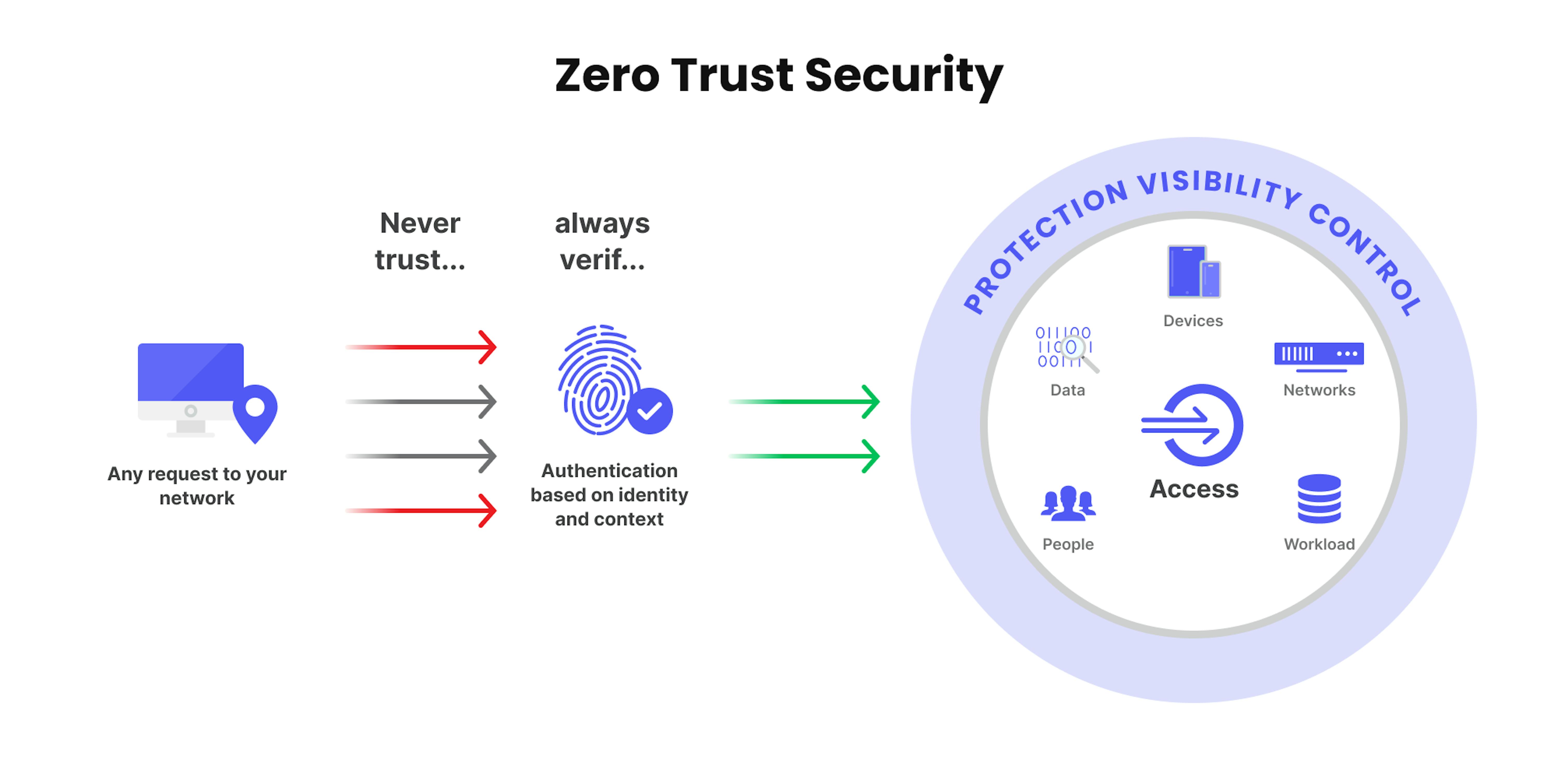
Zero Trust Architecture (ZTA) is a type of cybersecurity model that believes in the "never trust, always verifyprinciple. It assumes no user, device, or system is inherently trusted inside or outside the organization's network. In fact, it enforces strict access controls, continuous authentication, and monitoring for every interaction.

How Zero Trust Works

Verify Identity
Users and devices must authenticate at 
each access point using methods like MFA.
Enforce Least Privilege Access:
Access is granted only to resources necessary for the user or device's task, 
thereby minimizing over-privileged access.
Continuous Monitoring:
Activity is constantly analyzed for suspicious behavior using tools like User and Entity Behavior Analytics (UEBA) or Security Information and Event Management (SIEM).
Micro-Segmentation:
The network is divided into smaller segments to isolate resources, 
thereby limiting lateral movement in case of a breach.
Dynamic Risk-Based Policies:
Access decisions are 
also made in real-time using device health, geolocation, user behavior, and the sensitivity of the data accessed.
Encryption and Secure Communication:
Data is encrypted 
as it travels over public networks and it remains encrypted even when it's stored.
 

Key Technologies in ZTA
Identity and Access Management (IAM): 
Robust user authentication
Zero Trust Network Access (ZTNA): 
Contextual based access to applications.
Endpoint Security: 
Verifies the health and security posture of devices.
Data Loss Prevention (DLP): 
It monitors and protects sensitive information.

Benefits of ZTA
Better Security: It reduces the attack surface by assuming all users and devices are untrusted.
Better Incident Response: Continuous monitoring improves detection and response to threats.
Protection for Remote Work: Ensures secure access regardless of location or device.
Data Protection: Strict access controls and encryption safeguard sensitive information.

 "Find Out What Your Website’s Missing – Let’s Talk Today"

𝐄𝐯𝐨𝐥𝐮𝐭𝐢𝐨𝐧 𝐨𝐟 𝐒𝐞𝐥𝐟-𝐒𝐭𝐨𝐫𝐚𝐠𝐞 𝐔𝐧𝐢𝐭𝐬 𝐭𝐨 𝐌𝐞𝐞𝐭 𝐃𝐞𝐦𝐚𝐧𝐝𝐬 𝐨𝐟 𝐃𝐢𝐠𝐢𝐭𝐚𝐥 𝐒𝐞𝐜𝐮𝐫𝐢𝐭𝐲

  The self-storage units have transformed dramatically to respond to the increased demands of digital security. Self-storage facilities that...